Newsletter Subscribe
Enter your email address below and subscribe to our newsletter

Enter your email address below and subscribe to our newsletter
All voices matter
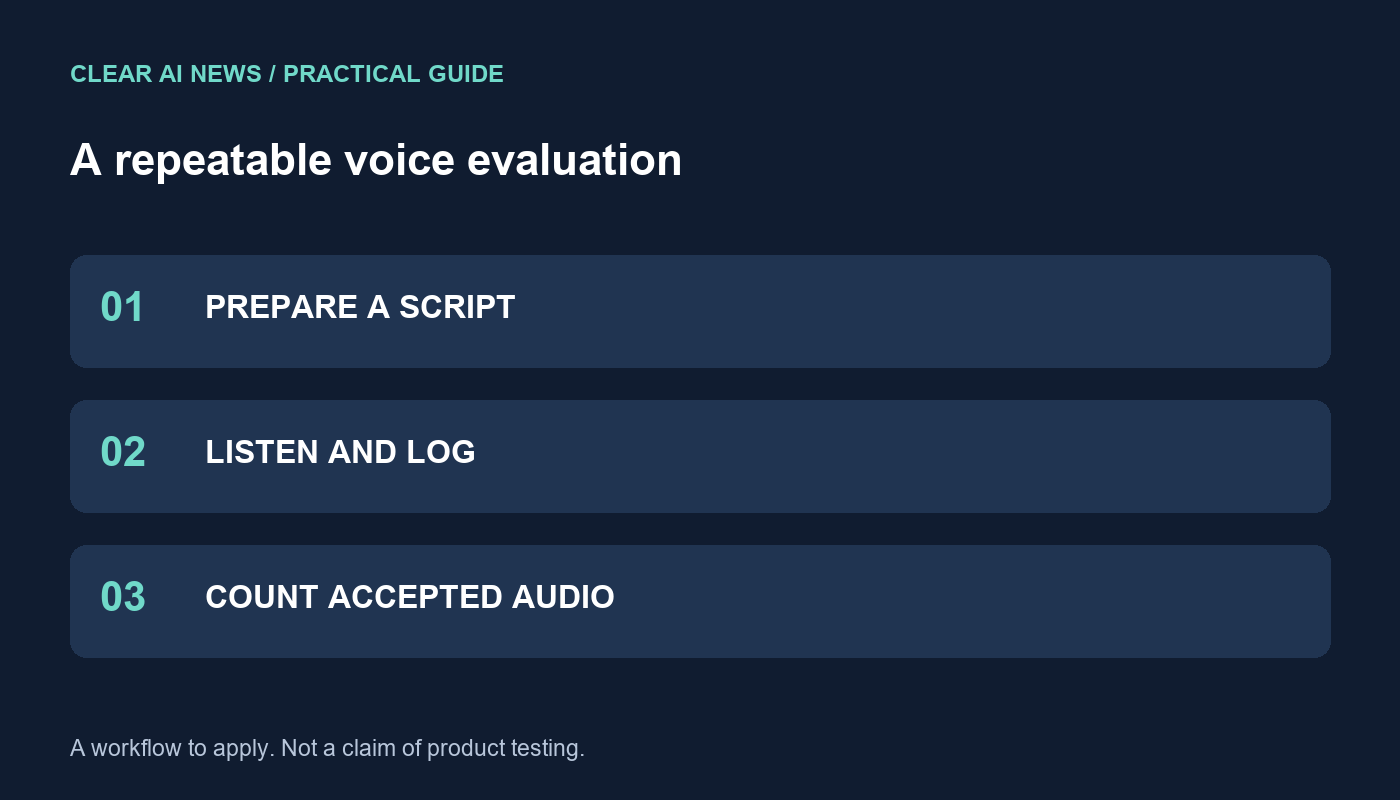
Use a repeatable script, pronunciation checks and an editing log to compare text-to-speech options for your own project.
A polished voice demo does not establish how a text-to-speech system will handle your script. A practical evaluation needs representative passages, a listening record and a clear definition of usable audio. This guide supplies that process. It does not report original listening-panel results, vendor stress tests or a universal winner.
Start with the intended audience, language, approximate length and delivery format. Use the AI glossary if you need help distinguishing speech generation from other AI tasks. Narration for a quiet tutorial has different needs from dialogue or a live voice interface. Specify whether a person will review every file before release and whether the workflow needs individual clips or a continuous recording.
Separate requirements from preferences. Correct names and numbers may be mandatory; a warmer tone may be desirable. A beautiful voice that changes a price, instruction or name has not passed the same test as a voice with slightly less appealing delivery but correct content.
Use text you own or have permission to process. Include a normal paragraph, a passage with names and abbreviations, a sentence with numbers, and a transition between sections. Add a second language only if it is part of the project and someone qualified can assess it.
For an invented practice line, try: “Dr. Morgan will review the API report on March 12. The example contains 1,250 entries.” Write the intended reading beside it, including how the date and abbreviation should sound. Use a genuinely representative longer passage as well; passing one sentence does not establish consistency across a chapter.
Save the service or model identifier, voice, language, settings, script version and generation date. Compare outputs at similar listening volume. Keep the first output alongside any regenerated version so the amount of repair remains visible.
ElevenLabs’ documentation distinguishes voice and model options, notes that output can vary between generations, and describes ways to provide context around longer text segments. Treat these as implementation details for that service. Do not assume another product accepts the same controls or that a particular setting guarantees error-free narration.
Use timestamps rather than a vague “sounds unnatural” note. If several listeners participate, let them record judgments before discussing the clips. Keep a modest evaluation labeled as a project-specific listening exercise; it is not a published scientific benchmark.
Count all generation charges for the trial, including unsuccessful attempts, and record editing time separately. Divide generation cost by the duration of audio actually accepted. If nothing passes, report no usable output rather than dividing by zero or treating the failed audio as completed work.
For a clearly hypothetical example, $6 in generation charges producing twelve accepted minutes is $0.50 per accepted minute, before editing and subscription allocation. It is not a vendor price. A comparison can change when retries or review time are included, so retain those values with the result.
Read the current terms for the exact plan, model and voice. A downloadable model and the software used to run it can have separate licenses. For example, the official Coqui XTTS-v2 model card names the Coqui Public Model License; the model’s availability alone should not be treated as blanket permission for every use.
Use voices and source recordings you are authorized to use. Before committing, export one accepted clip and confirm it works in the actual editing or playback application. Record the chosen configuration, remaining limitations and the conditions that would trigger another evaluation. Keep the decision tied to the project rather than a claim that one tool is best for everyone.
ElevenLabs text-to-speech documentation; Official Coqui XTTS-v2 model card and license reference; Fact-checking and corrections.
The tools, tutorials, and trends that actually pay — no hype.


The tools, tutorials, and trends that actually pay — no hype.