Newsletter Subscribe
Enter your email address below and subscribe to our newsletter

Enter your email address below and subscribe to our newsletter
All voices matter
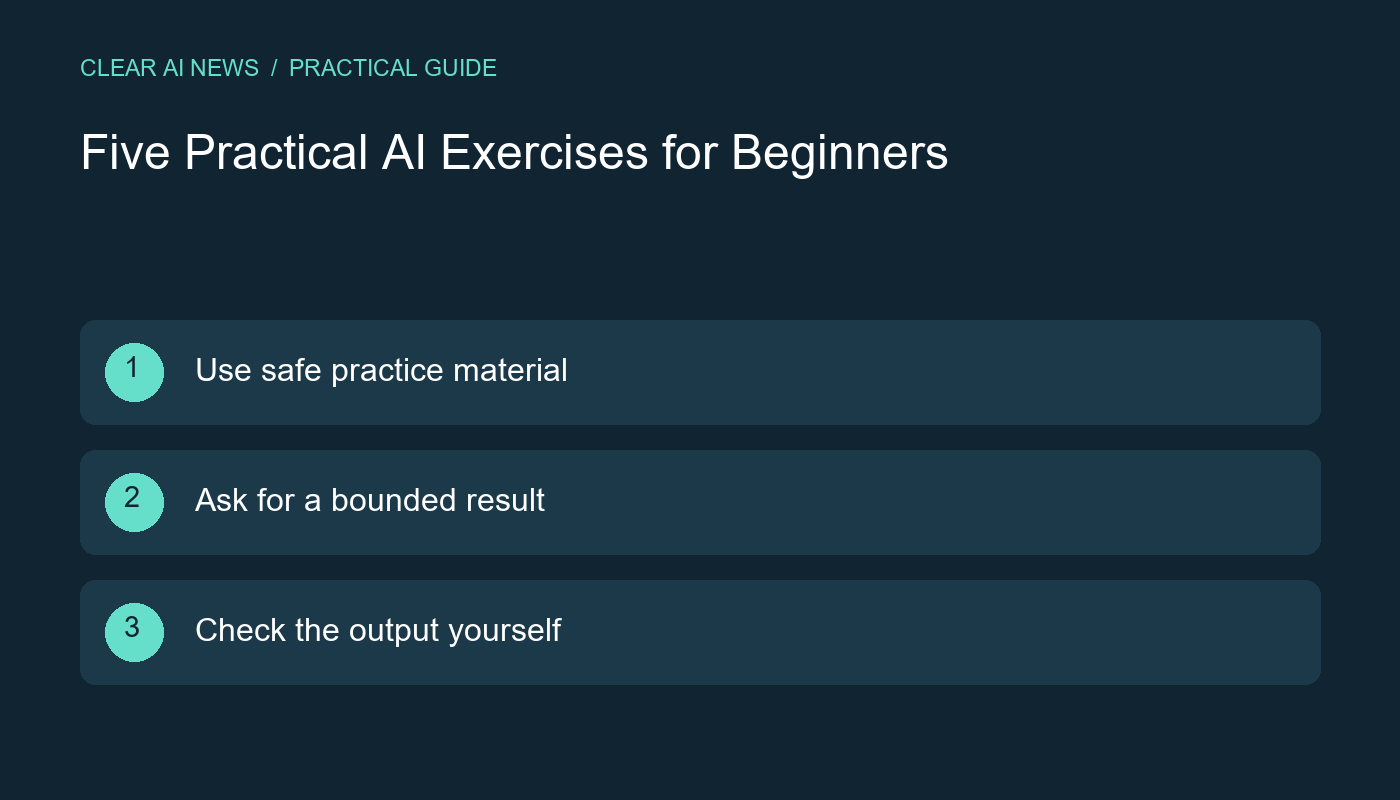
Try five bounded AI exercises using fictional or public material, with prompts, checks and clear stopping points for each task.
A useful first experience with AI starts with a small task and a clear way to check the result. You do not need to buy several subscriptions to learn this process. The five exercises below use fictional or public material and can be adapted to an assistant you already have permission to use. They are practice activities, not a ranking based on undocumented product testing.
Choose a short public document whose meaning you can check yourself. Ask: summarize this text in three points, use only the supplied information, and identify anything the text leaves unanswered. Keep the source visible while reviewing the answer.
Check whether each point is supported, whether an important qualification disappeared and whether the assistant added outside information. If the summary is wrong, identify the exact mismatch and request a correction. Your stopping point is a summary you can trace to the source, not an answer that merely sounds confident. This exercise teaches source comparison before you attempt larger research tasks.
Invent a simple situation with a few explicit facts: an order is delayed, the revised delivery date is Friday, and the customer can contact support for an update. Ask for a short courteous reply using only those facts and making no promises about refunds or compensation.
Review the result against the brief. Did it invent a tracking number, promise a discount or change the delivery date? Revise the draft until it stays within the supplied facts. Do not send the exercise to a real customer. The skill being practiced is controlling the scope of a draft and checking commitments before they leave your hands.
Write a fictional set of event-planning notes with tasks, owners and a few missing details. Ask the assistant to produce a checklist and mark missing information as unresolved rather than filling it in. For example, the notes might specify a venue and speaker but omit the arrival time.
Compare the checklist with the original notes. Every named owner and date should come from the notes, and missing details should remain visible. This exercise is useful because formatting can make invented information look authoritative. A neatly organized checklist still needs a person to verify what it says.
Describe a fictional community workshop and ask for a design brief containing the audience, headline, required facts, visual hierarchy and export requirements. Use a real design tool only if you already have access and understand its terms. Treat generated wording and imagery as material to review.
Check whether the brief communicates the event clearly at a small screen size. Remove unsupported claims and unnecessary text. If you produce an image, inspect the exported file rather than only the editor preview. The Canva evaluation guide offers a more detailed approach to checking finished design work and deciding whether a paid feature helps.
Write two versions of directions for a simple, low-risk activity, such as organizing a fictional reading list. Ask the assistant to identify ambiguities and explain which version is easier to follow. Require it to quote the relevant wording rather than give a vague preference.
Then make your own decision. Did it notice missing prerequisites? Did it criticize a detail that was already explained? Improve one instruction and repeat the comparison once. The aim is to learn what useful feedback looks like, not to accept every proposed edit or make the writing conform to a detector score.
For each exercise, record the task, input, output, correction and lesson. Avoid entering passwords, private customer records or material you lack permission to share. If you cannot verify an answer, choose a simpler exercise with a source you understand.
After several tasks, review which activities helped and which created extra checking work. Our guide to measuring an AI pilot explains how to include review time, and the glossary covers unfamiliar terms. Upgrade a tool only when a specific need and its current account terms justify the decision. No fixed time saving or subscription recommendation follows from completing these exercises.
Canva Pro evaluation guide; Measuring an AI pilot; AI glossary.
The tools, tutorials, and trends that actually pay — no hype.


The tools, tutorials, and trends that actually pay — no hype.