Newsletter Subscribe
Enter your email address below and subscribe to our newsletter

Enter your email address below and subscribe to our newsletter
All voices matter
Use Google's documented requirements and a practical page-review worksheet to check AI Search eligibility without invented ranking formulas.
Preparing a page for Google’s AI search features begins with ordinary site quality and accessibility. It does not require a secret writing formula or a paid tool that promises guaranteed inclusion. This guide separates Google’s documented requirements from a practical review process you can apply to one page. The worksheet is an editorial method, not a claim of measured ranking gains.
Google’s AI-features documentation says there are no additional technical requirements or special optimizations for AI Overviews and AI Mode. A supporting page must be indexed and eligible to appear in Search with a snippet. Meeting those conditions does not guarantee that Google will index or display it.
The same documentation says no special AI text file or schema is required. It describes AI-feature traffic as part of the overall Web performance reporting in Search Console. These statements do not establish a vendor-specific writing score, a guaranteed inclusion rate or a universal formula for page length.
Write down what someone should be able to do after reading the page. For a tutorial, that might be completing a documented setup step. For a comparison, it might be understanding the trade-offs that matter to a particular use case. Read the page without its promotional blocks and ask whether it actually fulfills that purpose.
Do not expand it simply to meet a supposed minimum word count. Google’s people-first guidance explicitly rejects the idea that it has a preferred word count. Add material when it resolves a reader’s unanswered question, supplies evidence or explains an important limitation.
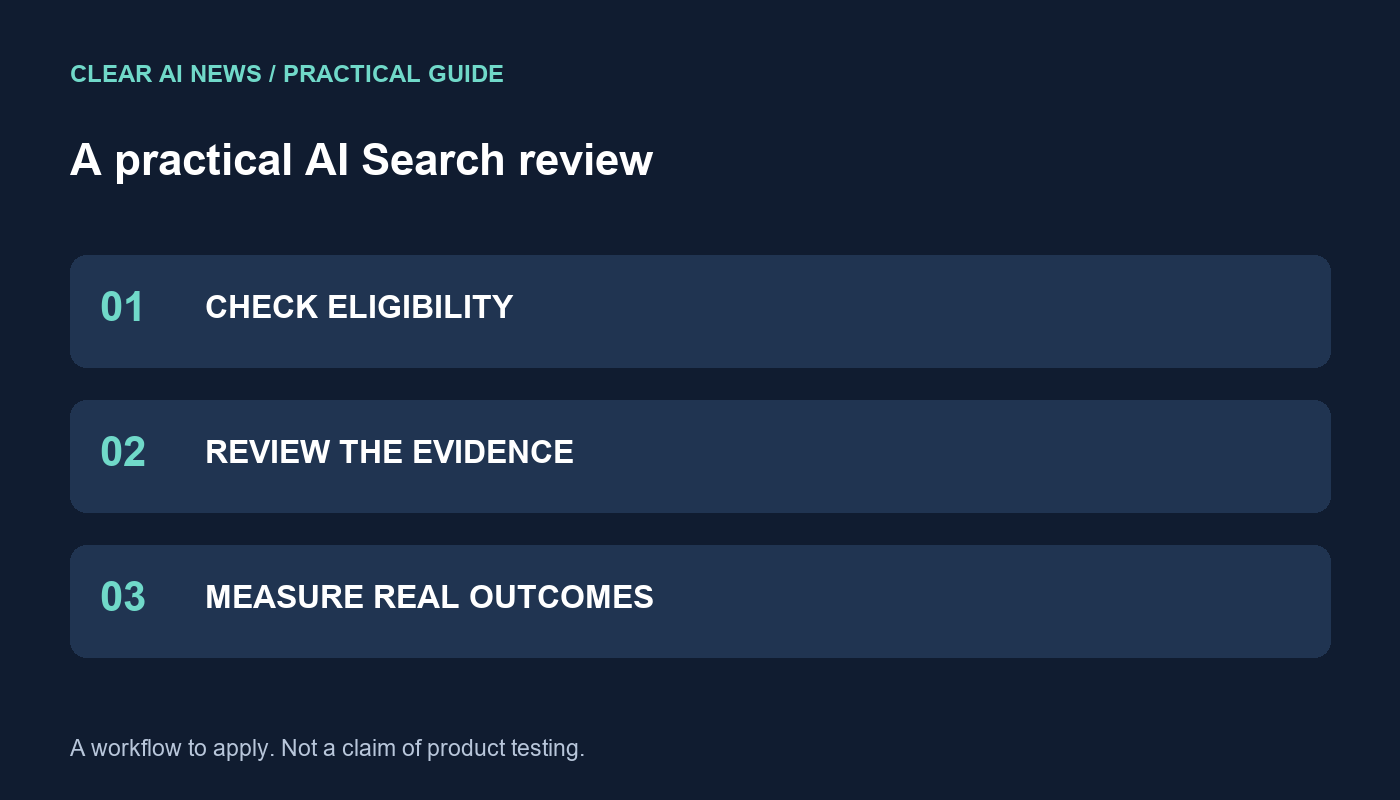
Record the public URL, response status, canonical destination and whether the main text is available to a visitor. Then inspect the page’s status in Search Console if you control the site. Note the date and what the report actually says; a successful page load is not proof of indexing.
Maintain separate rows for technical access and editorial usefulness. “The URL loads” and “the instructions are complete” are different findings. If a redirect is involved, follow the destination and make sure the reader reaches the relevant page rather than an unrelated homepage.
Open sources for important numbers, quotations and product capabilities. Confirm that each source supports the nearby statement, including its date and scope. A link to a company’s homepage does not substantiate a detailed claim about an unpublished model architecture.
Google’s guidance on generative AI content emphasizes reviewing accuracy and trustworthiness, including metadata. For your own review, flag statements that describe an author’s product use, customer surveys or original tests. Keep them only when supporting records exist and the wording accurately describes the work. Our fact-checking page provides a route for reporting a source concern.
An invented example is a tutorial that gives a menu label from an older product version. The useful correction is to verify the current documented path and explain which version it applies to. Adding an unrelated FAQ or increasing keyword repetition does not repair that instruction.
Keep a dated change log and compare relevant periods in your available analytics. Record useful outcomes, such as readers reaching a linked resource or completing the intended action. Note other changes that could affect the comparison, including seasonality, publishing activity and product demand.
A traffic increase after an edit does not prove the edit caused it. Preserve the observation and its limits. If the page still fails its reader task, fix that concrete problem before buying another optimization tool. For AI-assisted workflows, the editing-cost worksheet can help track the actual review effort.
Google: AI features and your website; Google: helpful, reliable, people-first content; Google: generative AI content guidance.
The tools, tutorials, and trends that actually pay — no hype.


The tools, tutorials, and trends that actually pay — no hype.