Newsletter Subscribe
Enter your email address below and subscribe to our newsletter

Enter your email address below and subscribe to our newsletter
All voices matter
Build an AI news reading routine that separates announcements, research findings and practical changes, with a reusable claim-checking worksheet.
An AI headline can describe a new product, a laboratory result, a company forecast or a change in regulation. Those stories require different kinds of evidence. Reading them as interchangeable signals of progress makes it easy to mistake an impressive demonstration for a dependable tool. This guide offers a practical reading routine: identify the kind of claim, locate its source, and decide whether it changes anything you actually do.
Choose a narrow question before opening your news feed. A teacher might want to know whether a tool can export accessible lesson materials. A developer might need to know whether an API interface is changing. A curious reader might want to understand how a model was evaluated. These questions create a useful filter. A story can be accurate and still have little relevance to your task.
Keep a short watchlist with a topic, a reason for following it and a next action. For example: document summarization; need traceable quotations; inspect the product documentation when a relevant feature appears. Avoid making the watchlist a collection of every company mentioned in the news.
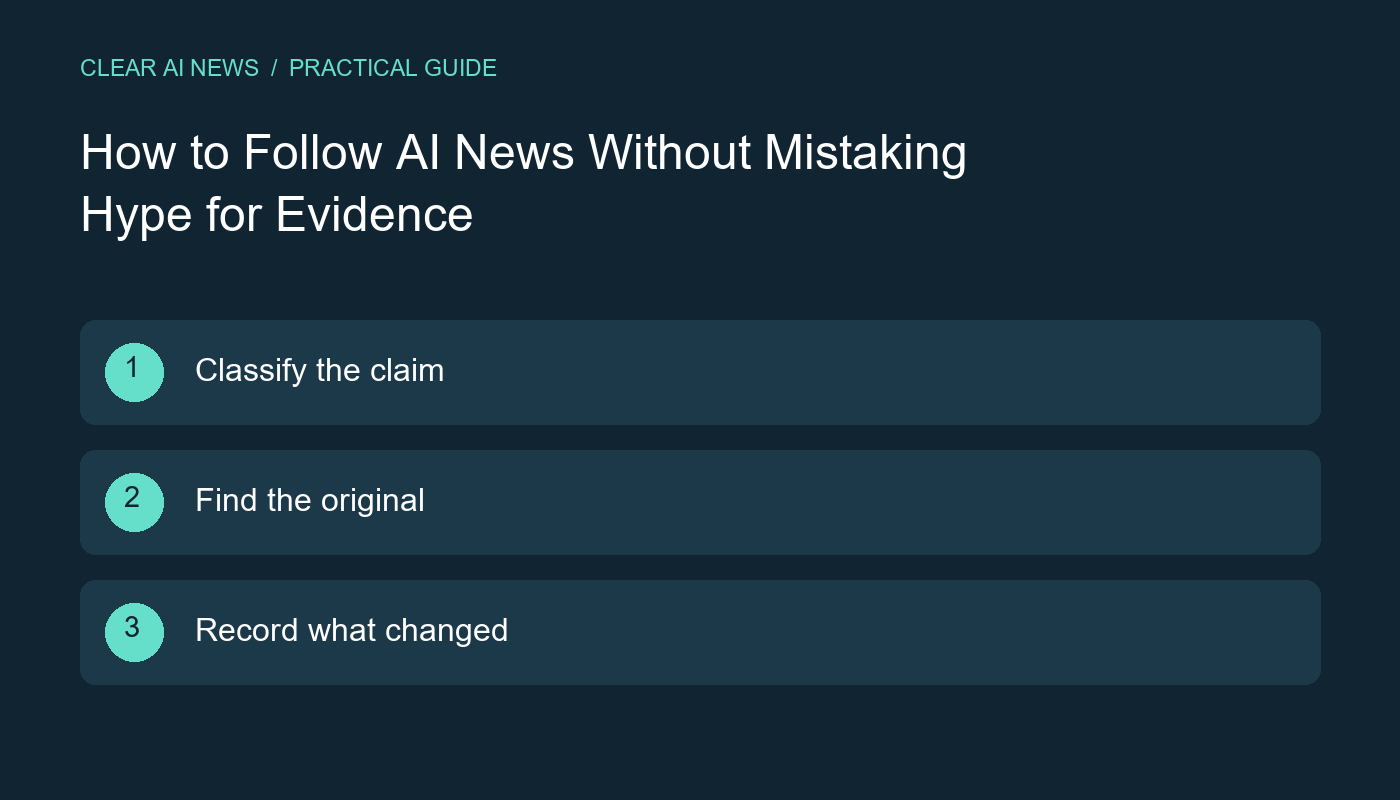
Label each item as an announcement, an evaluation, an adoption report or a policy development. An announcement establishes what an organization says it is offering. It does not independently establish quality. An evaluation needs a defined task and method. An adoption report needs a population and a clear definition of adoption. A policy story needs the actual instrument, jurisdiction and effective dates.
Consider this fictional headline: a new assistant transforms customer support. If the source is a launch page with a demonstration, your note should say that a vendor announced an assistant. Keep the broader performance claim unconfirmed until there is evidence about real support tasks.
Open the research paper, release note, dataset description or official notice rather than stopping at a summary. Check that the linked document actually supports the sentence that cites it. Matching an institution's name is insufficient: a paper about allocating objects does not establish how a language model performs on unfamiliar data.
For model releases, a model card can be a useful starting point. Hugging Face's documentation describes model cards as places to report intended uses, limitations, training and evaluation information. The presence of a card is not a guarantee that its contents are complete or independently verified.
Record the event date separately from the article's publication date. A newly updated webpage may discuss an older experiment. A product announcement may describe a staged rollout. A paper can have several versions, with later changes to methods or conclusions. Save the version or dated release entry you used so that another reader can locate the same evidence.
For stories about rules, follow our guide to checking AI regulation claims. Proposed language, enacted rules and a requirement already in force can have very different practical consequences.
Use five fields: claim, original source, scope, uncertainty and next action. For a hypothetical writing assistant, the claim might be that it supports a particular export format. The source could be its documentation. The scope might be a specific account plan. The uncertainty might be availability in your account. The next action would be to test export with a non-sensitive sample.
This note helps you avoid silently upgrading a narrow fact into a broad conclusion. It also makes later corrections easier: change the field affected by new evidence instead of rewriting your entire understanding of the tool.
A short reading session should end in a decision: ignore the story, save it for later, or investigate one concrete question. Repeated summaries of the same press release are not additional independent evidence. If a claim cannot be traced, mark it unresolved. You do not need to supply a confident answer to every headline.
For unfamiliar vocabulary, use our glossary before comparing claims. For corrections or source concerns, see our fact-checking page. This workflow is an editorial recommendation, not a measured claim that a particular reading habit improves productivity.
Hugging Face: model card documentation; Checking AI regulation claims; AI glossary; Fact-checking and corrections.
The tools, tutorials, and trends that actually pay — no hype.


The tools, tutorials, and trends that actually pay — no hype.