Newsletter Subscribe
Enter your email address below and subscribe to our newsletter

Enter your email address below and subscribe to our newsletter
All voices matter
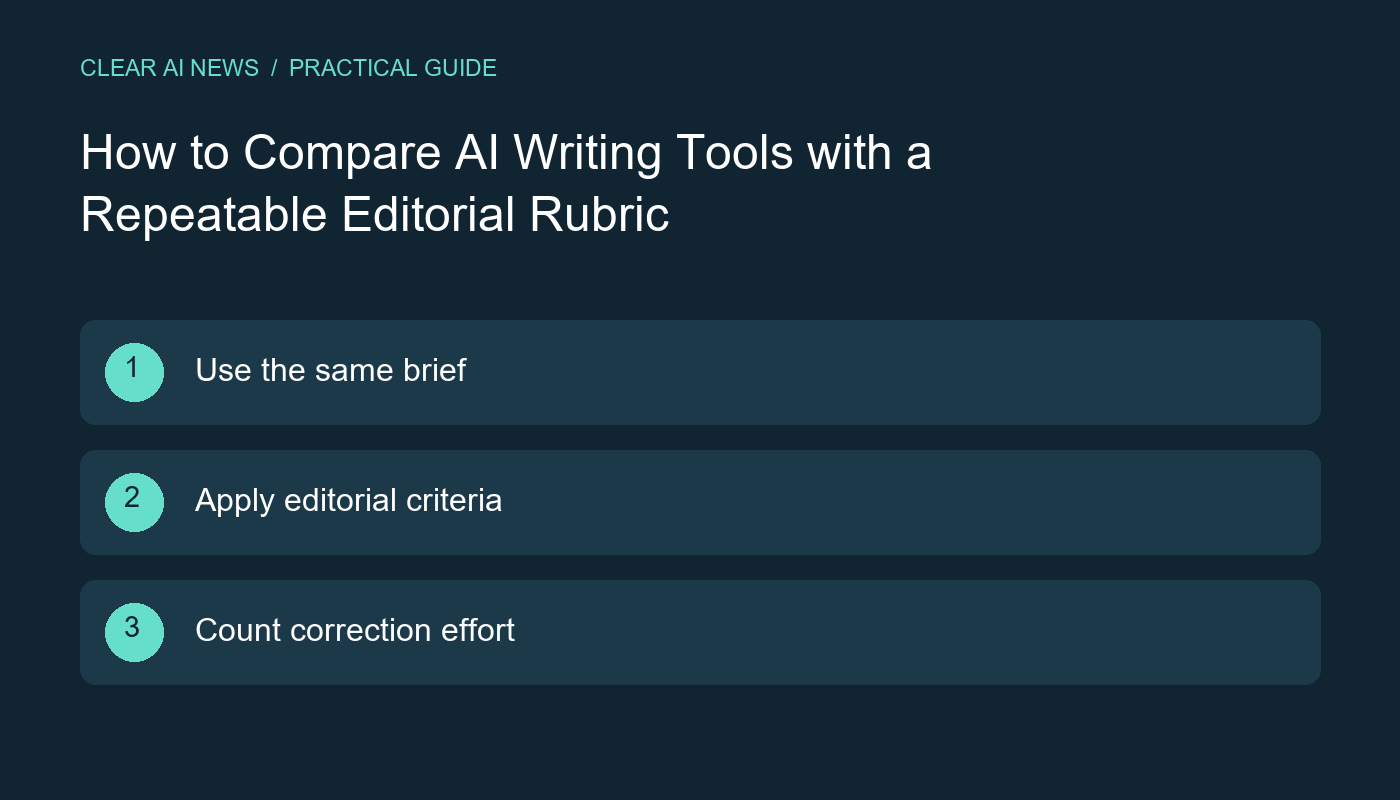
Compare writing tools using the same brief, factual checks and editing rules. Includes a practical rubric and a clearly hypothetical cost example.
An AI writing tool should be evaluated on the work you need to publish, including the editing required to make its output usable. A broad best-tool ranking hides those details. This guide provides an original comparison procedure and rubric. It does not report a three-month product trial, an editor panel or measured performance results.
Choose a realistic task and supply the facts the draft is allowed to use. Include the intended reader, purpose, length range, required points and prohibited claims. For a fictional product description, you might supply dimensions and materials while explicitly excluding health claims and invented testimonials.
Keep that brief unchanged across candidates. Record the relevant account plan, settings and date because product behavior and access can change. Avoid selecting a different easy task for each tool. You want to compare responses to the same editorial problem, not compare unrelated demonstrations chosen to show each product at its best.
Evaluate factual support, completeness, reader usefulness, tone and correction effort separately. For factual support, check each specific claim against the supplied material or an appropriate source. For completeness, mark which required points were included. For tone, cite an example of wording that matches or conflicts with the brief.
Use simple labels such as acceptable, needs revision and unacceptable. Define the labels before reviewing outputs. An unsupported product claim should not be canceled out by an attractive headline in an averaged score. Record serious failures individually so that a polished style cannot conceal a factual problem.
If one person reviews every candidate, use the same order of checks and keep notes explaining each decision. If several people review, agree on the definitions and compare a few example decisions before evaluating the full set. Differences in judgment should be recorded rather than replaced with an unsupported claim of precise agreement.
Where practical, review drafts without emphasizing the vendor name. This can help you focus on the text, but it does not transform a small internal comparison into an independent scientific study. Describe your method honestly, including the number and type of tasks reviewed.
Record preparation, generation, fact-checking, editing and final review. Include abandoned drafts and restarts. Keep setup time separate from recurring work, and use the actual price and allowance information for the account under consideration. A fast initial response may still require extensive correction.
Here is a hypothetical calculation. If a draft takes five minutes to obtain and twenty minutes to check and edit, the total is twenty-five minutes. Another draft taking ten minutes to obtain and ten to finish totals twenty minutes. These invented numbers illustrate why generation speed alone is not the appropriate comparison.
A tool that handles a short customer message may behave differently on a source-based explainer or a tightly constrained product description. Include the task types that matter to your editorial operation, and report conclusions for those tasks separately. Add a case where the supplied information is incomplete to see whether the draft invents missing details.
Use a worksheet containing task, candidate, criterion, evidence, correction and final decision. Preserve the brief and reviewed output when you are allowed to retain them. The benchmark-reading guide explains why sample selection and evaluation conditions matter when interpreting a comparison.
Select a tool only if its results and operating terms fit the intended workflow. Document where a person must approve the output and which failures mean the draft cannot be published. Revisit the comparison when a relevant product change or new task makes the earlier evidence less applicable.
Google's guidance emphasizes helpful content and distinguishes appropriate AI use from automation intended to manipulate rankings. A writing-tool score cannot establish search performance or AdSense approval. The business-pilot guide helps evaluate total effort, while our fact-checking page provides a route for reporting source problems. The useful outcome is a defensible editorial process, not an unsupported universal winner.
Google Search guidance on AI-generated content; Reading benchmark scores; Measuring an AI pilot; Fact-checking and corrections.
Generic rankings obscure the specific editing effort a tool requires for your unique projects. A repeatable rubric evaluates tools based on your actual publishing needs. This data-driven approach compares outputs for the same editorial problem, preventing misleading comparisons from unrelated demonstrations.
Prepare a consistent brief with a realistic task, key facts, and constraints. Specify the intended reader, purpose, length, required points, and prohibited claims. For a product description, supply dimensions and materials while excluding health claims. This controlled input ensures you compare responses to an identical editorial problem.
Check each specific claim against the source material you supplied. Use a simple label like ‘unacceptable’ for unsupported claims. Record serious factual failures individually to ensure a polished writing style does not conceal critical errors. This prevents averaged scores from masking fundamental problems.
Agree on clear definitions for evaluation criteria like ‘acceptable’ or ‘needs revision’ beforehand. The review team should compare decisions on a few sample outputs first. This calibration minimizes differences in judgment before evaluating the full set, ensuring consistent and reliable results.
The tools, tutorials, and trends that actually pay — no hype.


The tools, tutorials, and trends that actually pay — no hype.