Newsletter Subscribe
Enter your email address below and subscribe to our newsletter

Enter your email address below and subscribe to our newsletter
All voices matter
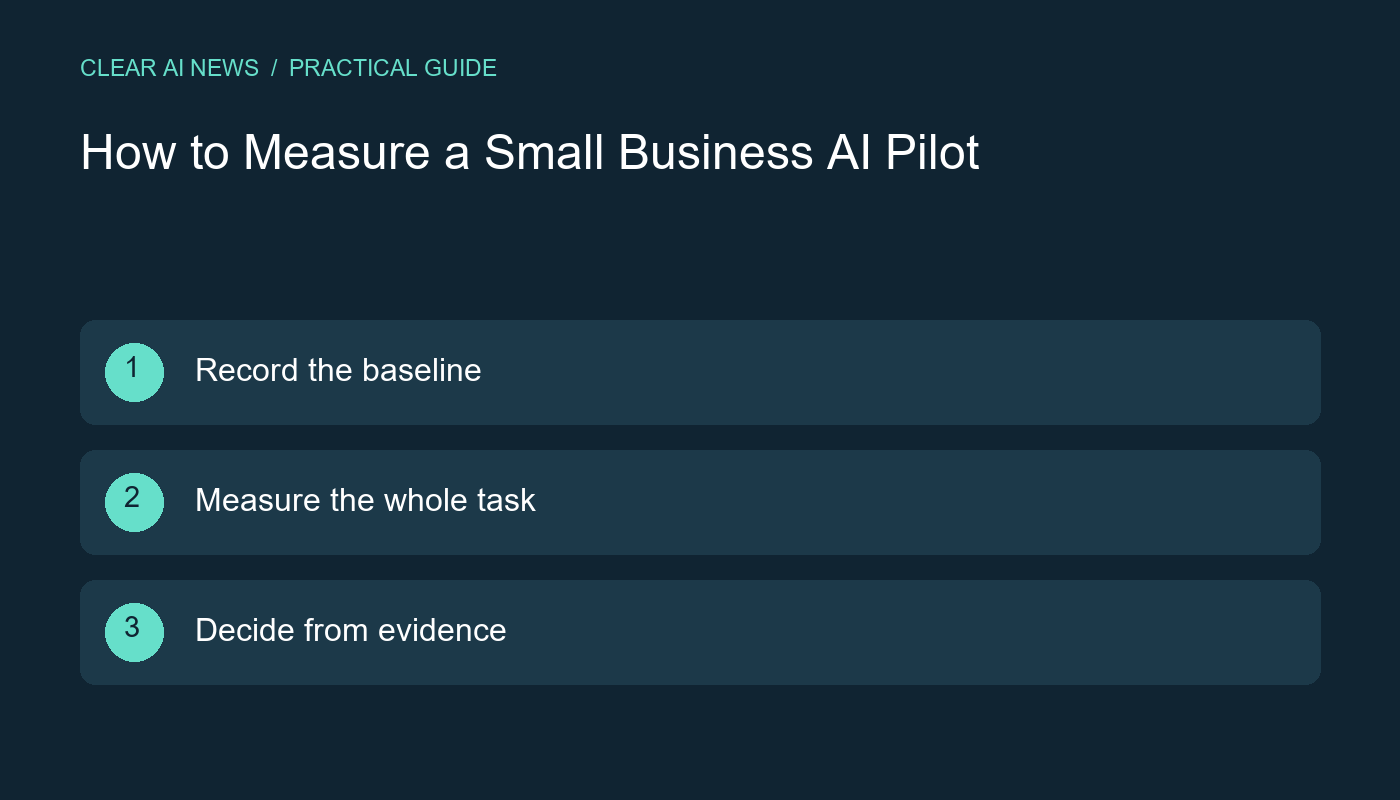
Plan an AI pilot with a baseline, quality checks, total task time and a clear stop-or-expand decision. Includes an explicitly hypothetical example.
An AI pilot is useful when it answers a specific operational question. Can this workflow produce acceptable work with less total effort? Which errors does it introduce? What must a person still check? Industry adoption statistics cannot answer those questions for your business. This guide provides a practical measurement worksheet, with an invented example to show the calculations rather than a promise of savings.
Start with a task whose inputs and outputs you can describe. Drafting a response to a common delivery question is more manageable than automating customer service. Identify the person responsible for approving the output and the situations the pilot must exclude. Use information you are permitted to process, and establish how access and retention will be handled before uploading business records.
Write the task boundary as a sentence: prepare a draft answer using the supplied order facts, with a staff member checking it before sending. That boundary makes it possible to measure both useful work and the review needed to make it acceptable.
Record the time spent completing comparable tasks without the proposed tool. Include checking, correction and handoff, not just typing. Describe the complexity of each case so that an easy AI-assisted sample is not compared with a difficult manual sample. If your baseline is only a rough estimate, label it that way.
Keep a simple worksheet with task type, completion time, review time, errors and final acceptance. Define acceptance before the pilot begins. A draft that looks polished but gives the wrong refund policy should fail a rule about factual accuracy even if it was produced quickly.
Measure preparation, tool interaction, waiting that prevents other work, review and correction. Record setup and training time separately from recurring task time. Include subscription or usage charges in your cost worksheet, using the actual terms that apply to your account. Do not treat a fast first draft as a finished task.
Track rejected outputs too. If staff abandon a draft and start again, that work belongs in the record. Otherwise the pilot can look successful simply because the difficult cases disappeared from the calculation. Note why each rejection happened so that you can distinguish a fixable instruction problem from a poor fit for the task.
Suppose ten comparable tasks take eight minutes each in the existing process: eighty minutes in total. In an invented pilot, preparing and generating the drafts takes twenty minutes, and reviewing and correcting them takes forty minutes. Total assisted time is sixty minutes, leaving a twenty-minute difference for that sample.
Now suppose setup required ninety minutes. The first batch has not recovered that setup time. If later batches behaved identically, several would be needed before cumulative time savings exceeded setup time. This arithmetic illustrates the measurement; it is not observed performance, a forecast, or evidence that another business will achieve the same result.
Choose a few error categories that matter: incorrect facts, missing required information, inappropriate tone and unsupported promises are possible examples. Give reviewers a consistent rule for each category. Preserve enough context to understand a failure while limiting access to sensitive material. Averages should not hide a serious error that the workflow cannot safely tolerate.
Ask staff what extra work the tool creates. They may spend time checking plausible but incorrect details or explaining the process to colleagues. These costs can be difficult to capture in a timer, but a brief structured note is better than assuming they are zero.
Set decision criteria before reviewing the results. You might require acceptable factual quality, manageable review effort and no unresolved data-handling issue. If the sample is small or unrepresentative, the reasonable next step may be a better pilot rather than a wider rollout. Keep the existing process available while resolving failures.
Document the decision, its evidence and the date for another review. Our guide to choosing AI tools helps distinguish coding assistance from predictive modeling, and our glossary explains common terminology. The worksheet here is an original planning framework, not a survey of industry results or a guarantee of financial return.
Choosing between coding assistance and automated modeling; AI glossary.
The tools, tutorials, and trends that actually pay — no hype.


The tools, tutorials, and trends that actually pay — no hype.