Newsletter Subscribe
Enter your email address below and subscribe to our newsletter

Enter your email address below and subscribe to our newsletter
All voices matter
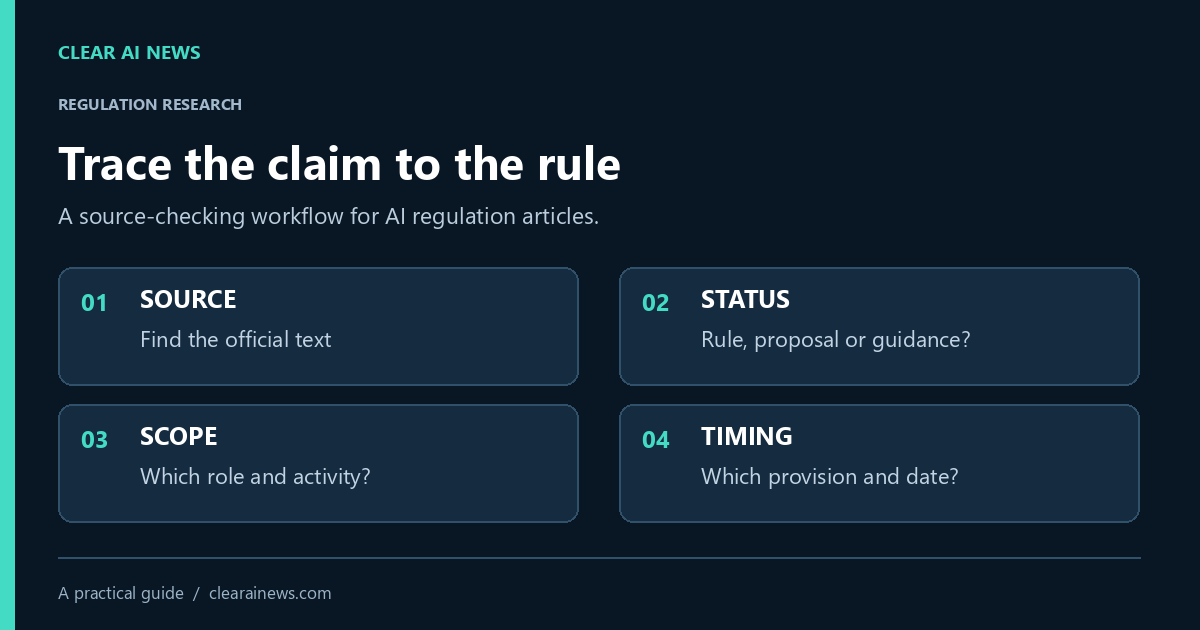
A practical source-checking workflow for AI regulation claims: distinguish legal duties from voluntary guidance, record scope and dates, and verify unsupported statistics.
An AI regulation headline is useful only when you can connect it to the actual rule, the affected activity and the date on which an obligation applies. A percentage about business adoption or consumer trust cannot tell you whether a particular system is covered.
This guide provides a practical way to check a regulatory claim and build a source record. It is an educational research workflow, not a determination that a specific business complies with the law. Sources were checked on October 16, 2026. For a decision affecting a real deployment, the responsible legal or compliance reviewer should assess the relevant text and circumstances.
The European Commission’s AI Act overview describes different categories and obligations, including prohibited practices, high-risk uses, transparency requirements and general-purpose AI models. The intended use and the organization’s role matter. A vendor calling a product an “assistant” does not, on its own, settle the classification of the activity it performs.
The NIST AI Risk Management Framework is explicitly intended for voluntary use. It offers a way to organize risk work; adopting it is not equivalent to establishing compliance with every applicable law. Keep the framework’s recommendations and a statute’s requirements in separate columns in your research record.
Copy the claim you need to assess into a worksheet before paraphrasing it. Then fill in the following fields. If a field is unknown, record that uncertainty instead of supplying a plausible answer.
| Field | What to record |
|---|---|
| Source | The official document, exact section and direct URL |
| Status | Whether the document is a proposal, adopted rule, guidance or commentary |
| Scope | The activity, location and organization role being discussed |
| Timing | The relevant commencement or application provision and any transition |
| Action | What the source actually requires or recommends |
| Review | The reviewer, review date and unresolved questions |
Keep a copy or dated reference to the material used for a consequential decision. A page may change later. A source record lets another reviewer see why you reached a conclusion and identify which assumptions need checking again.
Suppose a fictional employer is considering software that ranks job applications. Start with the actual workflow: what information goes in, what score comes out, who sees it and whether that score affects which applicants receive interviews. The label on the product page is less informative than a written account of those steps.
The Commission includes employment-related AI among its examples of high-risk uses. That is a reason to investigate the applicable provisions, definitions and exceptions; it is not a complete legal opinion about this fictional product. Record the employer’s and supplier’s roles, the countries involved and the intended deployment date, then take that record to the appropriate reviewer.
Contrast this with a separate tool that merely corrects spelling in a draft job advertisement. The two tools should not automatically inherit the same conclusion just because both use AI. A useful inventory describes each use rather than attaching one blanket label to the whole company.
Distinguish the date a law enters into force from the date a particular obligation starts to apply. Also distinguish a proposed change from a change that has completed the relevant legal process. An older article may accurately describe what was expected at publication while still being unsuitable for a decision today.
Use the Commission overview as a starting point and follow its links to the operative text and relevant guidance. Do not assume that one widely repeated implementation date applies to every category. In your worksheet, identify the exact provision supporting the date you use and schedule a review when the deployment plan changes.
A sentence such as “most companies already follow this framework” is an empirical claim, not an explanation of the framework. To support it, an article needs an identifiable study with a population, collection date, method and definition of “follow.” Linking to the framework’s home page does not supply that evidence.
The same applies to claims that a law mandates oversight for a fixed share of all AI systems. Before repeating such a statement, find the provision and determine whether it really describes a numerical quota or instead defines duties for particular systems and uses. If the source cannot be located, omit the statistic and explain what the official material does establish.
Finish with a short decision note: the use being considered, the sources reviewed, the unresolved questions and the person responsible for the next step. Include the data involved, the people affected, the review arrangements and what would trigger a reassessment. These are suggested documentation fields, not a claim that completing this checklist satisfies every legal obligation.
For a hypothetical customer-support chatbot, a useful next step might be reviewing how users are told they are interacting with software and how uncertain answers reach a person. For the hiring example, a useful next step is a classification and impact review before use. The workflow determines the question; the source determines what can be asserted.
See our editorial standards and fact-checking policy for how we approach published claims. This article makes no claims about adoption percentages, measured business benefits or completed legal review of a reader’s system.
The tools, tutorials, and trends that actually pay — no hype.


The tools, tutorials, and trends that actually pay — no hype.