Newsletter Subscribe
Enter your email address below and subscribe to our newsletter

Enter your email address below and subscribe to our newsletter
All voices matter
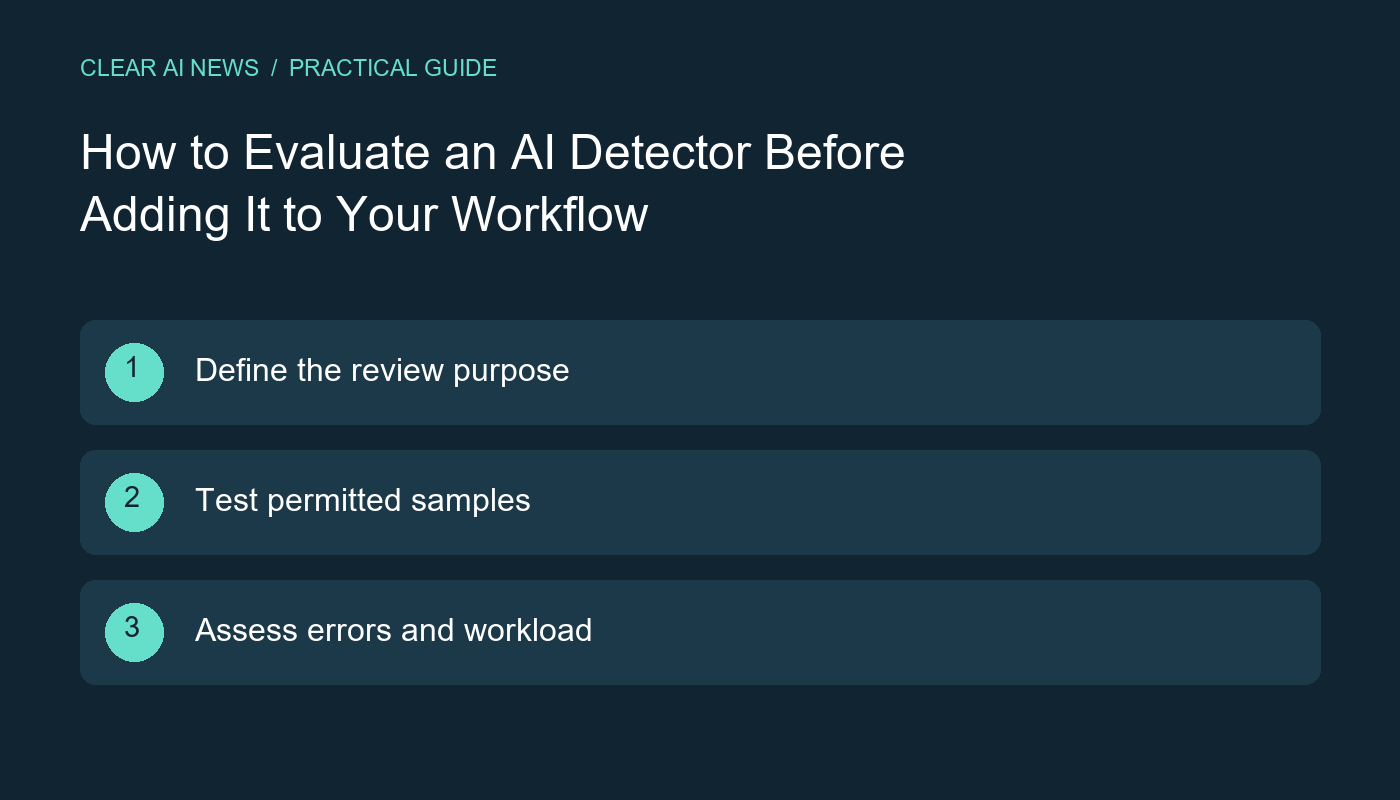
A practical evaluation worksheet for AI detectors covering sample selection, error costs, privacy, report interpretation and review workload.
Choosing an AI detector involves more than comparing advertised accuracy. You need to know whether its reports answer a useful question, whether the writing may be submitted to the service and what happens when the result is wrong. This guide provides a proposed evaluation process. Its basis is documented limitations and a proposed evaluation worksheet, rather than comparative product results.
Write down the decision before selecting a product. An editor checking whether a contributor followed an agreed process has a different need from a researcher comparing classifiers. A vague aim such as ensuring authenticity makes it difficult to decide what evidence would be sufficient.
Specify what the tool will never decide automatically. For example, a flagged submission might receive a source review rather than automatic rejection. Name the reviewer, the applicable rule and the evidence that reviewer can consider. If you cannot describe a fair follow-up action, reconsider whether adding the detector helps the workflow.
Use writing you have permission to process. Record how each sample was created, including any known assistance, editing or translation. Keep the reference information separate from the detector's output so that the output cannot silently become its own ground truth. Ambiguous samples should remain labeled ambiguous.
Include the kinds of material you actually receive: ordinary prose, short passages, technical language or translated documents where relevant. Do not infer broad reliability from a handful of conveniently selected examples. A small pilot can identify practical problems, but it is not a representative accuracy study without an appropriate sampling design.
For each sample, record the product version or evaluation date, settings, input length and returned result. Use the same permitted material when comparing products. Save the report definition alongside the output so that later reviewers understand what its score represents.
The benchmark-reading guide explains why different metrics and evaluation conditions can produce misleading comparisons. Apply that principle here: a claim about one language or document type should not become a claim about every document in your organization. If important conditions are undocumented, include that uncertainty in the decision.
Record how long a reviewer needs to understand the report and investigate a flag. Note cases where the result is unclear, changes the wrong decision or adds no useful information. Count legitimate writing sent for unnecessary review as well as AI-generated samples that were missed.
Use a worksheet with six columns: sample identifier, known creation process, detector result, review outcome, review time and unresolved issue. A result labeled uncertain is an acceptable entry. Avoid forcing every case into a confident binary conclusion simply to make the summary look cleaner.
Check the provider's current terms for retention, access, reuse, deletion and any relevant account controls. Identify who is allowed to submit documents and whether sensitive material must be excluded. Do not assume that a paid plan or a privacy-themed marketing statement answers these questions.
Start with non-sensitive samples while resolving uncertainties. If the service cannot meet a requirement of your organization, that is a reason to stop the evaluation even if its sample classifications look promising. Keep a record of the specific terms and date reviewed rather than relying on a remembered product description.
Summarize the intended use, sample limitations, observed errors, review workload and unresolved requirements. Choose whether to reject the tool, conduct a better evaluation or use it only for a narrowly defined supporting role. Set a review point if the product or writing population changes.
For report interpretation, begin with the vendor's own definition and use the AI glossary for unfamiliar terminology. Turnitin's own report documentation cautions against treating its assessment as the sole basis for adverse action against a student. A procurement worksheet cannot remove uncertainty; it makes the uncertainty and responsibility visible.
Turnitin: report interpretation and limitations; Reading benchmark scores; AI glossary.
The tools, tutorials, and trends that actually pay — no hype.


The tools, tutorials, and trends that actually pay — no hype.