Newsletter Subscribe
Enter your email address below and subscribe to our newsletter

Enter your email address below and subscribe to our newsletter
All voices matter
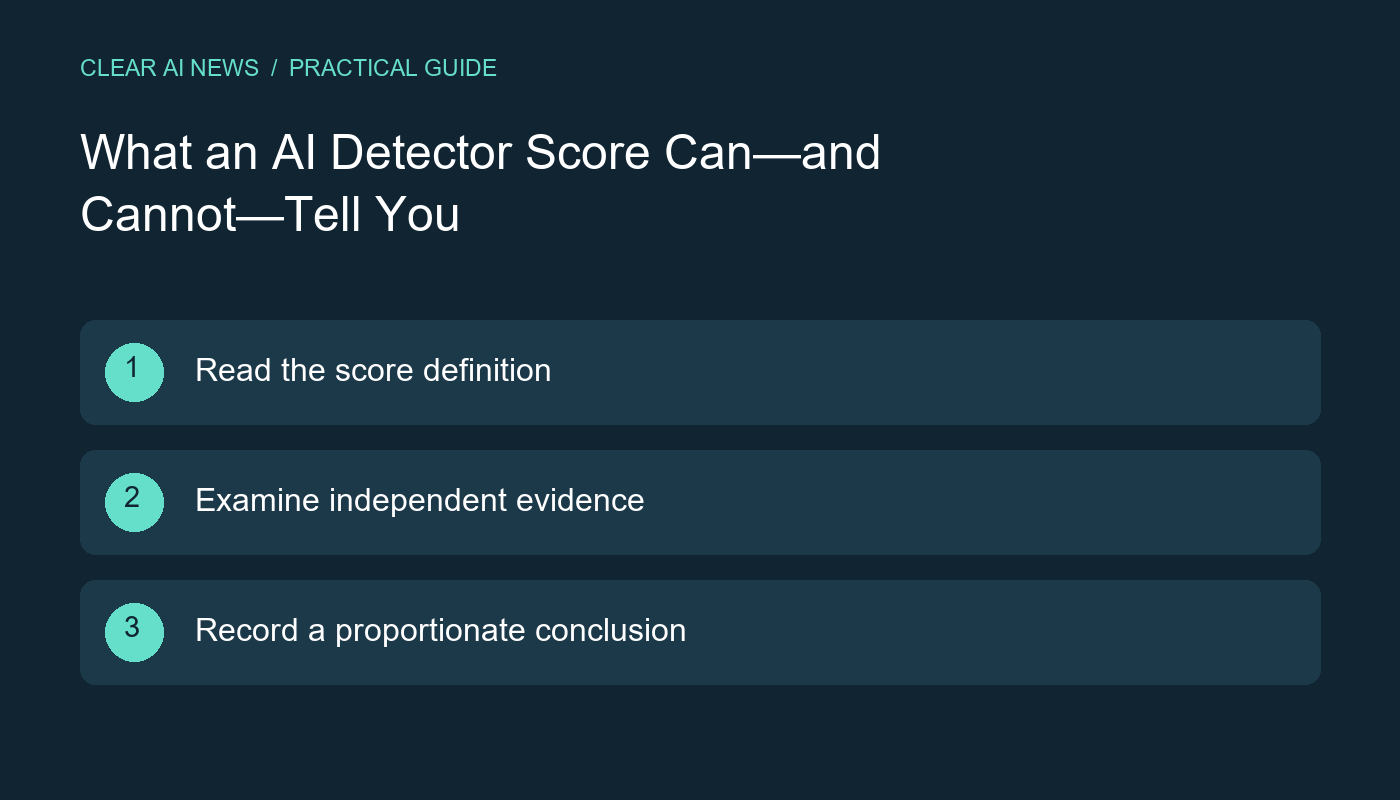
Understand AI detection scores, false positives and evidence limits before using a report to judge a piece of writing.
An AI detector produces a classification or score based on a piece of text. That result is not a record of how the text was created. Before acting on it, distinguish what the product reports from what you are trying to establish. This guide explains how to read a result, check its limitations and use other evidence without turning uncertainty into an accusation.
A percentage can describe different things in different products. It might refer to text classified into a category rather than the probability that a writer used an AI system. Read the documentation for the specific report and version. Do not transfer a definition from one vendor to another because the dashboards look similar.
Turnitin's documentation describes its report in terms of qualifying text identified as likely AI-generated. It also warns that the model can misidentify writing and should not be the sole basis for adverse action against a student. That limitation matters when interpreting a result, even if the displayed number looks precise.
A false positive occurs when a detector flags text that does not belong to the category being tested. A false negative occurs when it misses text that does. These errors have different consequences. A process designed only to catch more suspicious writing may also create more reviews of legitimate work.
Consider an invented example: a detector flags twenty of one hundred documents, but later evidence supports AI generation for only eight of the flagged documents. The flagged count alone cannot tell you how many classifications were correct. Without independent information about the documents, you cannot calculate meaningful error rates from the dashboard.
Look for the study date, detector version, languages, document types and source of the samples. A result from one collection of essays does not automatically establish performance on translated reports, short emails or technical documentation. A vendor's own evaluation is useful to inspect, but it remains a claim about the evaluation described.
A 2023 paper by Liang and colleagues examined bias against non-native English writers in the detectors and samples studied. It supports caution about those conditions, not a current accuracy ranking for every detector. For broader evaluation questions, see our guide to reading AI benchmark scores.
If authorship matters, consider relevant drafts, source notes, revision history and the author's explanation, subject to the rules and permissions of the setting. These materials can help explain how the work developed. Their absence is not automatically proof of misconduct, and a polished writing style is not sufficient evidence on its own.
A neutral question is more useful than an accusation: how did you develop this section, and which sources support it? Keep the discussion focused on specific requirements. An institution or publisher may permit some assistance and prohibit other uses, so establish the actual rule before judging compliance.
A detector does not establish that a statement is accurate, a quotation is correctly attributed or an image is licensed. Review those issues directly. A human-written article can contain fabricated references, and an AI-assisted draft can still require substantial factual checking before publication.
Google's Search guidance does not impose a blanket ban on appropriate AI use. It distinguishes useful content from automation used primarily to manipulate rankings. A low detector score therefore does not certify search compliance, and a high score does not by itself establish a violation of Google's guidance.
Write down the report source, date, relevant limitations, additional evidence and the decision actually supported. If the available information leaves authorship unresolved, say so. Avoid presenting a tool's classification as a fact about someone's conduct. Keep access to the report and underlying writing appropriate to the setting.
For an editorial workflow, a practical conclusion might be that a passage needs a source check or that the writer should clarify how a quotation was obtained. Those are specific actions tied to observable issues. The glossary explains common AI terms, and the fact-checking page describes how to raise a source concern.
Turnitin: using the AI Writing Report; Liang and colleagues: detector bias study (2023); Google Search guidance on AI content; Reading benchmark scores; AI glossary; Fact-checking.
An AI detector score reflects the tool’s classification of text, not a definitive record of its origin. The percentage might indicate text categorized as AI-like, not the probability a specific writer used AI. Definitions vary significantly between vendors, so you must consult the specific product’s documentation to understand what the reported metric represents accurately.
No, relying solely on a detector score for adverse actions like accusing a student is not recommended. These models can produce false positives, misidentifying human writing as AI-generated. The documentation for tools like Turnitin explicitly warns against using the score as the only evidence. You should always corroborate the result with other independent information.
A false positive occurs when the detector incorrectly flags human-written text as AI-generated. A false negative happens when it fails to identify actual AI-generated text. These errors have different consequences; a high rate of false positives leads to unnecessary reviews of legitimate work, while false negatives allow AI text to go undetected.
Check the study’s parameters, including the detector version, publication date, languages, and document types used for testing. Performance on one set of academic essays does not guarantee the same results on different text genres. Ensure the research conditions match your specific use case, such as business communications or creative writing, to assess the tool’s relevance accurately.
The tools, tutorials, and trends that actually pay — no hype.


The tools, tutorials, and trends that actually pay — no hype.