Newsletter Subscribe
Enter your email address below and subscribe to our newsletter

Enter your email address below and subscribe to our newsletter
All voices matter
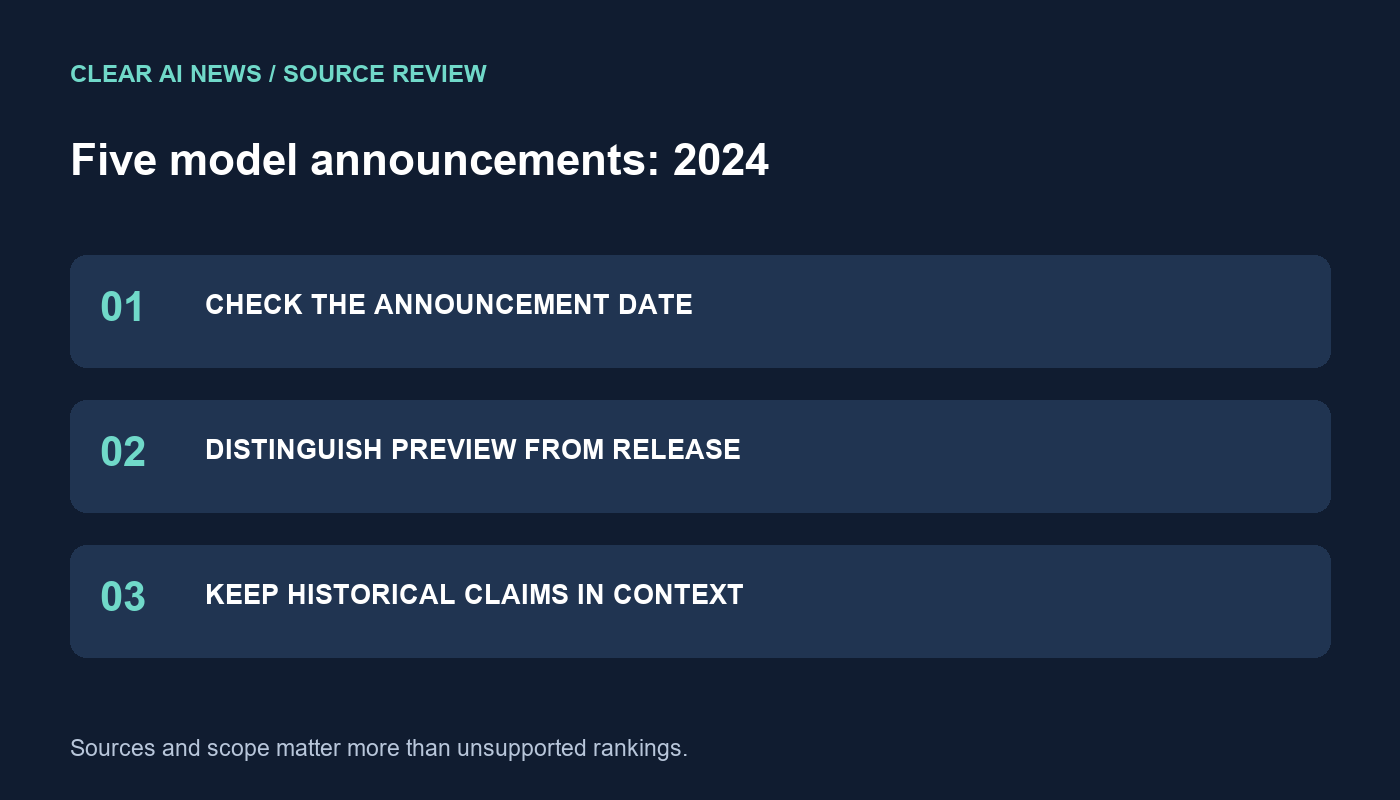
A sourced historical guide to Gemini 1.5, Claude 3, GPT-4o, Llama 3.1 and Mistral Large 2, separating announcements from availability.
The model announcements of 2024 are useful historical reference points, but they should not be read as a current buying guide. This article checks five announcements against their publishers’ original pages and separates announced capability from initial access. It does not report private deployment tests, compare current prices or claim that a launch demonstration predicts a business outcome. Corrections can be reported through our fact-checking page.
| Announcement date | Model or family | What to distinguish |
|---|---|---|
| 15 February 2024 | Gemini 1.5 | Experimental long context and limited preview access. |
| 4 March 2024 | Claude 3 | Family announcement and different availability dates. |
| 13 May 2024 | GPT-4o | Multimodal design and staged feature rollout. |
| 23 July 2024 | Llama 3.1 | The 405B release and its exact generation name. |
| 24 July 2024 | Mistral Large 2 | Available weights and their stated usage terms. |
These are dates on the linked announcement pages. They are not a promise that every account, region or interface gained every capability on that date. When reconstructing a historical comparison, preserve those access conditions alongside the model name.
Google announced Gemini 1.5 on 15 February 2024. Its description of Gemini 1.5 Pro distinguished a standard 128,000-token context window from an experimental window of up to one million tokens offered to a limited group in private preview. The announcement also described the model as multimodal.
The historical lesson is to read availability language as carefully as the headline number. A preview capability and a generally accessible product limit are different facts. This source does not establish present-day availability or a current price for processing a million tokens. Read Google’s announcement.
Anthropic introduced Claude 3 on 4 March 2024, naming Haiku, Sonnet and Opus. Its announcement stated that Opus and Sonnet were available then, while Haiku would follow. It also explicitly described the family’s ability to process visual material such as photographs, charts and diagrams.
That makes a blanket description of Claude 3 Opus as text-only inappropriate for a historical summary of this release. The announcement’s benchmark comparisons remain vendor-reported results; they are not evidence of this publication running its own compliance or document tests. Read Anthropic’s announcement.
OpenAI announced GPT-4o on 13 May 2024 and described a model trained across text, vision and audio. The same page distinguished that design from the initial public release of text and image inputs with text outputs, with other capabilities rolling out separately.
This distinction matters when reading older examples. A demonstration of a model capability does not establish that the same capability was available through every API or subscription at launch. Nor does it substantiate an unrelated accuracy figure for a private document collection. Read OpenAI’s announcement.
Meta’s 23 July 2024 announcement introduced Llama 3.1, including the 405B model, and described an expanded 128K context length. Referring to that release simply as an earlier Llama 3 model can obscure which model and documentation a reader should inspect.
For a historical record, keep the exact family and size together. Treat model distribution, deployment requirements and usage terms as separate questions. This article does not infer a hardware budget or a cost advantage from the parameter count. Read Meta’s announcement.
Mistral’s Large 2 announcement is dated 24 July 2024. It describes a 123-billion-parameter model with a 128K context window. The release distinguished research and non-commercial use under its research license from commercial self-deployment requiring a commercial license.
The publication date corrects a June date sometimes attached to this release. The licensing distinction also shows why the phrase “available weights” should not be expanded into an unrestricted-use claim. Anyone evaluating a deployment should inspect the terms applicable to their exact model and intended use. Read Mistral’s announcement.
For each historical claim, save the model name, source date, relevant passage and any preview restriction. Keep vendor-reported measurements separate from independent evaluations and from your own observations. If an article asserts a private experiment, it needs records of that experiment; linking a launch page cannot supply them.
These five announcements document different directions in model development. They do not establish a universal winner or current procurement shortlist. For a present-day decision, start with your task, current documentation and a repeatable evaluation. Our evidence-table guide provides a way to organize the source material before drawing a conclusion.
The tools, tutorials, and trends that actually pay — no hype.


The tools, tutorials, and trends that actually pay — no hype.