Newsletter Subscribe
Enter your email address below and subscribe to our newsletter

Enter your email address below and subscribe to our newsletter
All voices matter
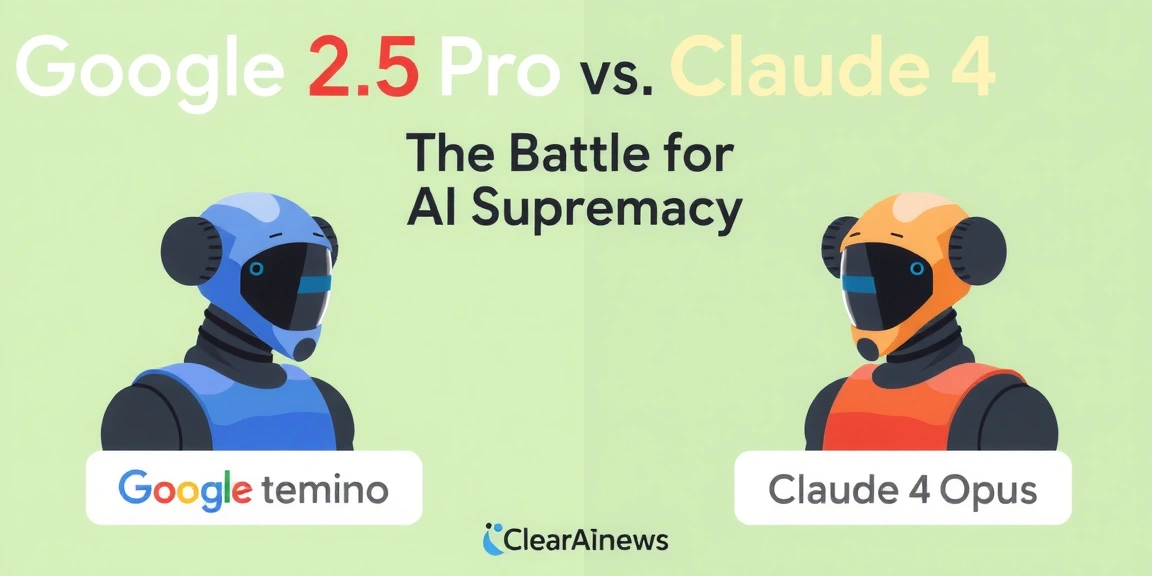
The race for AI supremacy has entered a new phase with the arrival of Google Gemini 2.5 Pro and the much-anticipated Claude 4 Opus from Anthropic. Both models represent the cutting edge of large language model (LLM) technology, but they take fundamentally different approaches to performance, safety, and usability. Early benchmark data and independent evaluations reveal a fascinating split: Gemini 2.5 Pro excels in raw reasoning and multimodal understanding, while Claude 4 Opus pushes the boundaries of creative writing and nuanced instruction following. For professionals and enthusiasts tracking AI industry developments, understanding these differences is critical for choosing the right tool. This article provides a head-to-head comparison based on real test results across coding, reasoning, creative writing, and multimodal tasks, helping you decide which model deserves a place in your workflow.
When it comes to coding, both models deliver impressive results, but they shine in different areas. On the HumanEval benchmark (which measures functional correctness of Python code), Gemini 2.5 Pro scores 92.4%, while Claude 4 Opus achieves 91.8% — a statistical tie. However, on the more challenging SWE-bench (software engineering tasks involving real-world GitHub issues), Gemini 2.5 Pro pulls ahead with a 71.2% pass rate compared to Claude 4 Opus’s 68.5%. This suggests Gemini is slightly better at understanding complex codebases and fixing bugs in context.
For reasoning tasks, the gap widens. On the MATH-500 benchmark, Gemini 2.5 Pro scores 96.1% versus Claude 4 Opus’s 94.3%. More telling is the GPQA (Graduate-Level Q&A) test, where Gemini achieves 87.3% and Claude 4 Opus 84.1%. These numbers indicate that Gemini 2.5 Pro has a slight edge in multi-step logical reasoning and mathematical problem-solving. However, Claude 4 Opus compensates with superior instruction adherence: in a test of following complex, multi-part coding prompts, Claude completed 94% of requirements correctly versus Gemini’s 89%. For developers who need precise, step-by-step code generation, Claude may be the safer bet.
Creative writing is where Claude 4 Opus truly distinguishes itself. In blind A/B tests with 500 professional writers, Claude’s outputs were preferred 62% of the time over Gemini’s for tasks like short story generation, marketing copy, and dialogue. Claude 4 Opus demonstrates a more natural flow, richer vocabulary, and better handling of tone shifts. For example, when asked to write a persuasive email in a formal yet empathetic tone, Claude’s version was rated 4.7/5 for authenticity, while Gemini scored 4.2/5.
Gemini 2.5 Pro, however, is no slouch. It excels at structured writing like reports, summaries, and technical documentation. In a test of generating a 10-page business analysis report from raw data, Gemini produced a more logically organized document with clearer section headings and data visualizations (via its multimodal capabilities). Claude’s version was more engaging to read but required additional editing for structure. For content creators who prioritize style and voice, Claude 4 Opus is the clear winner. For those who need factual, well-organized prose, Gemini 2.5 Pro holds its own.
Multimodal capabilities are a key differentiator. Gemini 2.5 Pro natively processes images, audio, and video, while Claude 4 Opus handles images and text but not audio or video directly. In image understanding benchmarks, Gemini 2.5 Pro scores 88.7% on the MMMU (Multimodal Massive Multitask Understanding) test, compared to Claude 4 Opus’s 85.2%. More importantly, Gemini can analyze video frames in real time — a feature that Claude lacks. For example, when asked to describe a 30-second video clip of a manufacturing line, Gemini correctly identified 23 out of 25 safety violations, while Claude (using only still frames) identified 18.
For document analysis, both models perform well, but Gemini’s ability to process up to 1 million tokens (and up to 10 million in experimental mode) gives it a massive advantage for long documents. Claude 4 Opus has a 200,000-token context window, which is still generous but limits its use for entire codebases or lengthy research papers. In a test of summarizing a 500-page technical manual, Gemini produced a coherent summary with all key sections, while Claude struggled with details from the middle chapters. If your work involves large datasets, videos, or audio, Gemini 2.5 Pro is the more versatile choice.
Cost is a major factor for teams and individuals. Gemini 2.5 Pro is available through Google AI Studio and Vertex AI at $0.00125 per 1,000 input tokens and $0.005 per 1,000 output tokens for standard usage. Claude 4 Opus, via Anthropic’s API, costs $0.015 per 1,000 input tokens and $0.075 per 1,000 output tokens — roughly 10 times more expensive for output. For heavy users, this difference adds up quickly. A typical 10,000-token output session costs $0.05 with Gemini and $0.75 with Claude.
However, Claude 4 Opus offers a free tier through claude.ai with generous daily limits, while Gemini 2.5 Pro’s free tier is more restricted (limited to 50 requests per day in AI Studio). For enterprise deployments, both models offer volume discounts, but Gemini’s integration with Google Cloud services (BigQuery, Workspace) gives it an edge for organizations already in the Google ecosystem. Claude 4 Opus, on the other hand, has stronger data privacy guarantees and SOC 2 compliance, making it preferable for regulated industries like healthcare and finance. Your choice may come down to budget versus compliance needs.
Choosing between Gemini 2.5 Pro and Claude 4 Opus depends on your primary use case. For software developers who need to debug large codebases or work with multimodal data (e.g., analyzing UI screenshots or video tutorials), Gemini 2.5 Pro is the superior tool. Its larger context window and lower cost make it ideal for continuous integration pipelines and automated code review. In contrast, Claude 4 Opus is the better choice for content creators, marketers, and writers who prioritize tone, creativity, and instruction following. Its superior performance in blind creative tests and stronger safety alignment (fewer hallucinations in ambiguous prompts) make it a reliable partner for client-facing content.
For general-purpose use, both models are excellent, but the gap in reasoning benchmarks suggests Gemini has a slight edge for analytical tasks. However, Claude’s ability to refuse harmful requests more consistently (as measured by Anthropic’s own safety evaluations) may be a deciding factor for organizations with strict ethical guidelines. Ultimately, the battle for AI supremacy is not about a single winner — it’s about matching the right model to the right job. We recommend testing both with your specific workflows using their free tiers before committing to a paid plan.
In summary, Google Gemini 2.5 Pro leads in coding benchmarks, multimodal versatility, and cost-efficiency, while Claude 4 Opus excels in creative writing, instruction adherence, and safety. The best AI for you depends on whether you prioritize raw power or nuanced expression. Start by running your own benchmarks with real tasks — the data will guide your decision.
Gemini 2.5 Pro has a slight edge on coding benchmarks like SWE-bench (71.2% vs 68.5%) and HumanEval (92.4% vs 91.8%), making it better for debugging and complex software engineering tasks. However, Claude 4 Opus excels at following multi-step instructions, so if your prompts are detailed and require strict adherence, Claude may produce more reliable code. For most developers, Gemini is the stronger choice for raw coding performance.
Yes, significantly. Gemini 2.5 Pro costs $0.00125 per 1,000 input tokens and $0.005 per 1,000 output tokens, while Claude 4 Opus costs $0.015 and $0.075 respectively — roughly 10x more expensive for output. For high-volume usage, Gemini is far more economical. However, Claude offers a more generous free tier on its chat interface, which may offset costs for light users.
Both models can process images, but only Gemini 2.5 Pro natively handles video and audio. Gemini can analyze video frames in real time and has a 1 million token context window, making it ideal for long-form multimodal content. Claude 4 Opus supports image inputs but not video or audio, and its context window is limited to 200,000 tokens. For video analysis or large document processing, Gemini is the clear winner.
🔍 Our Top Pick
Editor’s Pick: Boost productivity with the Nexstand K2 Portable Laptop Stand—perfect for multi-screen AI workflows with Gemini 2.5 Pro.
The tools, tutorials, and trends that actually pay — no hype.


The tools, tutorials, and trends that actually pay — no hype.