
Newsletter Subscribe
Enter your email address below and subscribe to our newsletter

Enter your email address below and subscribe to our newsletter
All voices matter
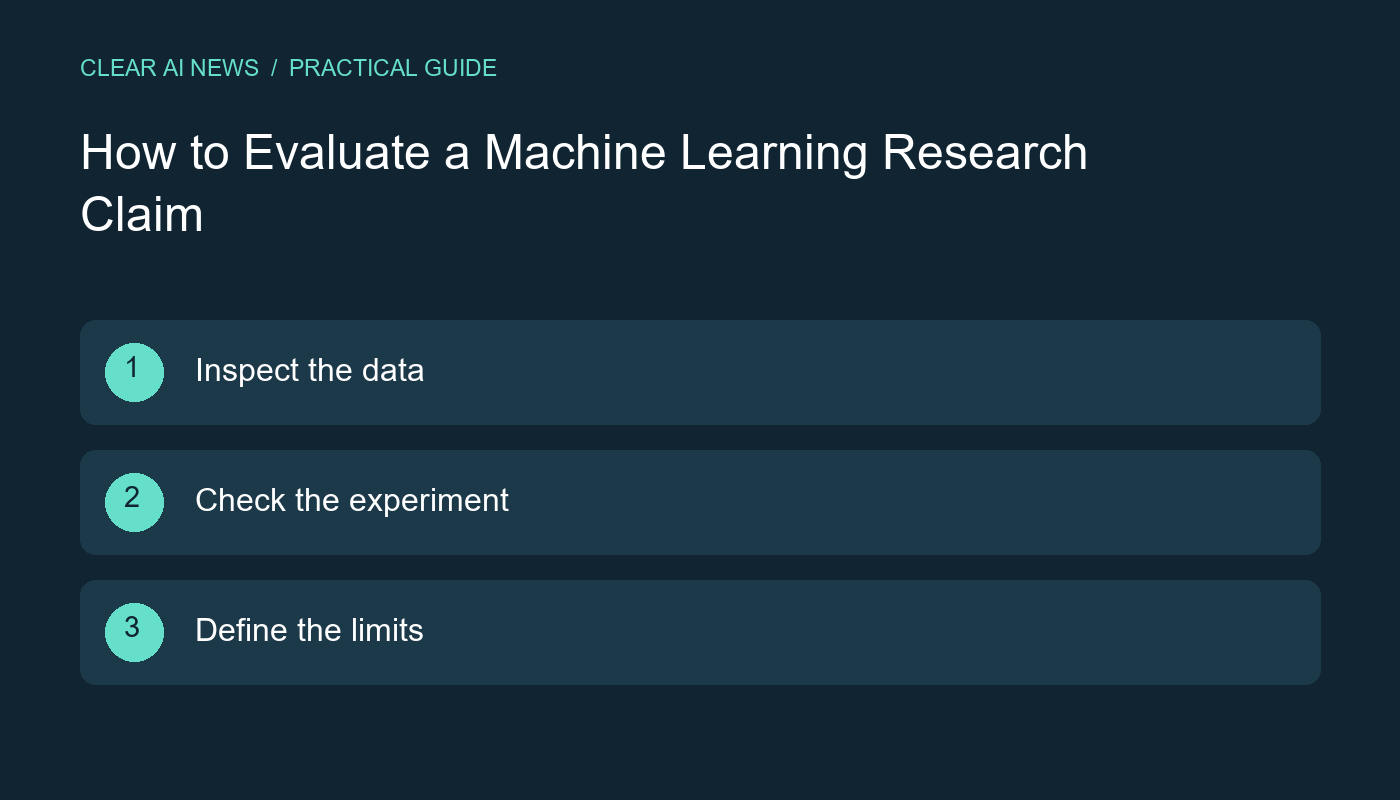
Read machine learning research with a practical checklist for task definition, data leakage, reproducibility, baselines and deployment limits.
A machine learning breakthrough should be understood as a claim about a specific experiment before it becomes a claim about the wider world. A paper may contribute a useful method while leaving deployment questions unanswered. The following reading process helps you identify the contribution, inspect how it was tested and describe the remaining uncertainty without dismissing the work or overstating its reach.
Translate the headline into one sentence that names the task, data and comparison. For example, a fictional paper might report lower forecasting error than two baselines on a particular collection of historical demand records. That is a much more testable claim than saying a new model changes business forecasting.
Keep the authors' result separate from your interpretation. If the paper evaluates one kind of data, do not present success on other kinds as established. Write those possible applications as questions. This simple distinction helps keep a research summary useful even when the experiment is promising.
Find the data source, collection period, inclusion rules and train-test split. Ask whether the examples resemble the intended use case and whether different records may come from the same person, organization or event. Related records crossing between training and evaluation can make the evaluation easier than a genuinely new case.
For a fictional equipment dataset, several readings from the same machine may share identifying patterns. A test intended to measure performance on previously unseen machines would need to account for that relationship. The correct split depends on the question being asked; randomly dividing rows is not automatically sufficient.
Scikit-learn's common-pitfalls documentation explains that using information unavailable at prediction time can produce overly optimistic evaluation results. It recommends splitting training and test data before learning preprocessing steps, and using pipelines to help keep transformations within the appropriate training process.
Turn that principle into specific questions. Was feature selection performed before the split? Does an input column reveal an event recorded only after the outcome? Was the final test set repeatedly used to choose settings? These are checks on the method, not accusations about the authors. If the paper lacks enough detail, record that limitation.
A useful comparison explains both the proposed method and the alternatives. Look for comparable access to training data, computing resources and tuning effort. If a paper adds several changes at once, an ablation experiment can help show which changes contributed to the result. Without such a comparison, attributing the gain to one named component may be premature.
Read the failure discussion alongside the strongest result. Note tasks where the method did not improve, cases excluded from evaluation and costs not represented by the headline metric. A method can be valuable for a narrow setting without being a universal replacement.
Look for code, dependency information, data access instructions, evaluation scripts and relevant settings. Availability of these materials makes inspection easier, but it does not mean you have reproduced the findings. Use precise language: code available, method described, or results independently reproduced only when there is evidence for that last statement.
If you plan to run the experiment, first define a small verification goal. You might check that the data-loading script works and that one baseline can be evaluated under the documented setup. Record any substitutions. A result obtained with different data or settings should not silently inherit the original paper's claims.
Deployment adds questions about input drift, latency, operating cost, monitoring and handling errors. These are practical evaluation needs, not reasons to reject a research contribution. Ask what would happen when the input is incomplete, unfamiliar or incorrectly formatted, and who would decide whether an output is usable.
Finish your notes with three statements: what the paper demonstrated, what you could verify from the materials, and what remains unknown for your application. The benchmark-reading guide helps interpret reported scores, while the glossary explains common terms. This article is a reading checklist and contains no claim that we reran the cited documentation's examples.
Scikit-learn: common pitfalls and recommended practices; How to read an AI benchmark score; AI glossary.
The tools, tutorials, and trends that actually pay — no hype.


The tools, tutorials, and trends that actually pay — no hype.