Newsletter Subscribe
Enter your email address below and subscribe to our newsletter

Enter your email address below and subscribe to our newsletter
All voices matter
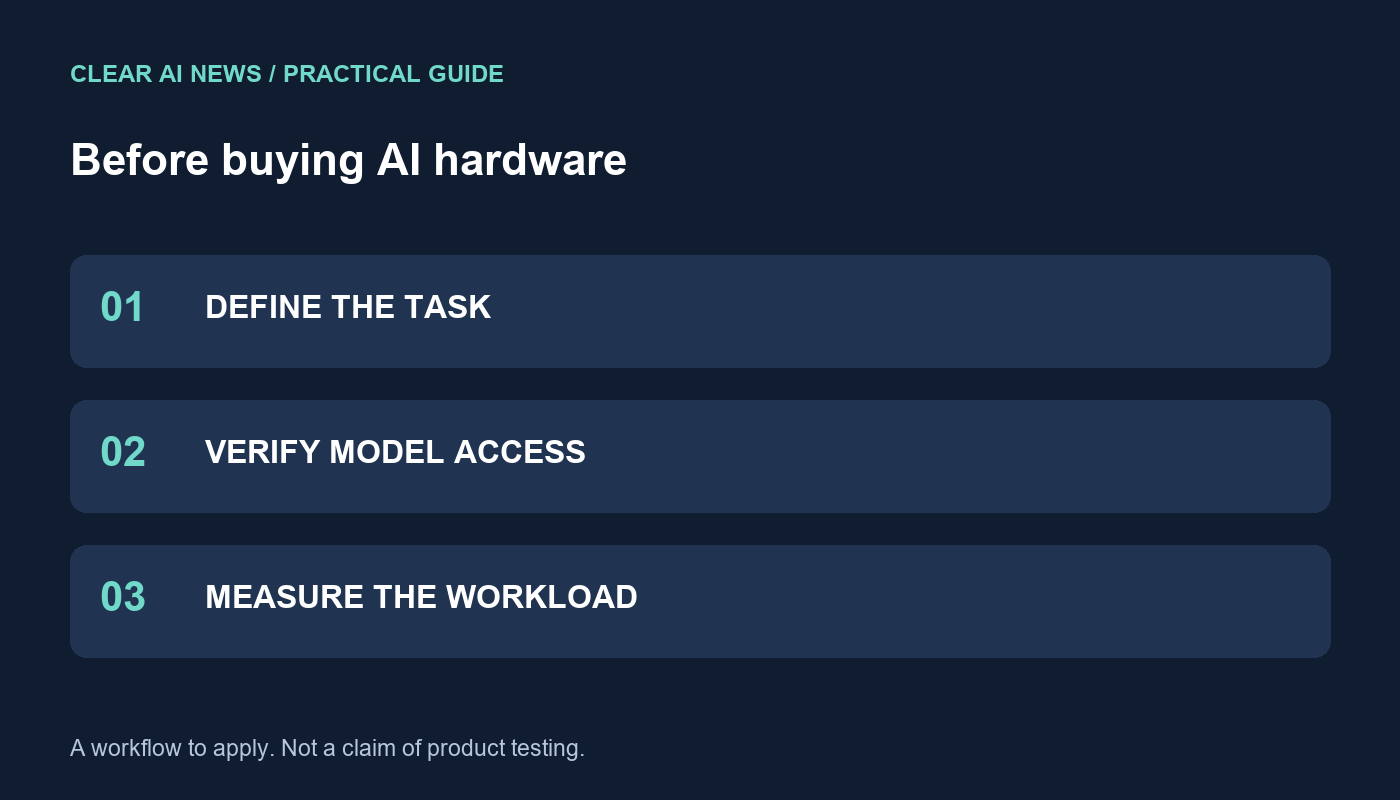
Separate benchmark claims from deployment requirements, and build a small evidence-based plan before buying hardware for local AI.
A high benchmark score does not tell you which computer to buy. Before choosing between a hosted AI service and a model running on your own hardware, establish what you need to do, whether the model is actually available to run locally, and what a useful result would look like. This guide provides a decision worksheet, not a ranking from original hardware tests.
Write one concrete requirement: summarize public meeting notes, classify support requests, or answer questions from a small document collection. Specify the input length, required output, acceptable delay and who checks the result. An impressive result on a reasoning benchmark may tell you little about a system’s handling of your documents.
A useful historical example is ARC Prize’s December 2024 o3 report. It recorded 75.7% and 87.5% on its semi-private evaluation under different compute settings. The report later clarified that the released o3 was not the same version as the preview tested. ARC Prize also cautioned that passing the benchmark would not establish AGI. Treat those figures as results of the described experiment, not a current buying recommendation.
A chat interface, an API and downloadable model weights are different forms of access. The AI glossary can help separate unfamiliar terms before comparing deployment options. A service available through a browser does not automatically provide weights for installation on your workstation. Before planning a local deployment, find the exact publisher repository, model identifier, license and supported inference software.
Use the model card to inspect intended uses and limitations. Hugging Face’s documentation explains the role of model cards in describing models, training information and evaluation context. Read the actual card and accompanying license for your candidate; the presence of a download button is not a complete suitability assessment.
Do not select a GPU using model size alone. Record the model format, precision or quantization, input context, simultaneous requests and software requirements. These choices affect the system you need. Leave room for the operating system and other applications rather than assuming every advertised gigabyte is available for inference.
Ollama’s FAQ explains how its processor display distinguishes CPU, GPU and split loading, and how parallel requests and context affect memory allocation. That is useful deployment documentation, not proof that a particular model will meet your speed target. Start with hardware you already have when practical and measure the intended workload before committing to an upgrade.
For a hosted service, record actual usage charges, any subscription allocation and the time spent correcting results. For a local setup, include hardware allocation, electricity, maintenance and review time. Keep one-time setup separate from recurring operation so a short trial does not disguise a long-term support burden.
Define an accepted output before comparing costs. A cheap response that needs extensive repair may cost more to use than a slower response that meets the brief. Record failed attempts too. Do not present an assumed hourly workload as measured demand.
Use public or fictional material for an initial comparison. Local execution alone does not establish privacy: inspect connected services, logging and access controls. Likewise, a hosted service’s settings should be checked for the specific account and feature you intend to use.
Write down the bottleneck an upgrade must solve. If the candidate model cannot be licensed or run in the required environment, additional hardware will not resolve that problem. If the existing system already meets the task, preserve the measurements and postpone the purchase. Revisit the decision when the workload or requirements change.
ARC Prize’s dated o3 evaluation; Hugging Face model cards; Ollama deployment FAQ; Reading AI benchmark scores.
The tools, tutorials, and trends that actually pay — no hype.


The tools, tutorials, and trends that actually pay — no hype.